The Corner Booth Is the New Corner Office
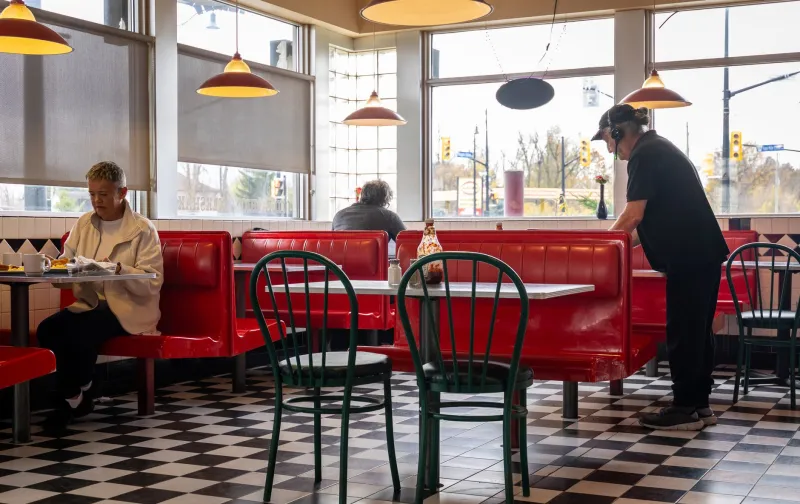
The corner booth at a diner on the east side of Providence seats four, technically. On a Tuesday afternoon in 2026 it is holding one laptop, two sweating glasses of iced tea, a sketchbook, and a woman named Dana who has spent the last forty minutes rereading the same paragraph — not because she is stuck, but because the man two stools down just said something about his boat that quietly rearranged her entire second act.
That is what a third place does. It does not make you more productive. It makes you more porous.
The Home Office Solved the Wrong Problem
Somewhere around 2020 we collectively turned spare bedrooms into studios and kitchen tables into conference rooms, and honestly, the productivity gains were real. Better chairs. Better light. A door that actually closes. We optimized the hell out of the place where work happens.
What we never optimized was the place where ideas happen, and those are not the same room. A home office is excellent at execution. It is terrible at interruption — at eavesdropping, at the accidental sentence from a stranger that knocks your brain sideways. Everything about a well-designed home studio is engineered to keep the world out. Which is great for finishing things and quietly disastrous for starting them.
Sociologist Ray Oldenburg called the informal gathering spots between home and work third places back in 1989, and for decades the concept lived mostly in urban planning seminars. Then the home office ate the commute, the lunch break, and the incidental collisions that used to happen in elevators and grocery lines, and suddenly a lot of people started mourning a room they had never bothered to name.
What a Third Place Actually Gives You
Not Wi-Fi. Not oat milk. Not a community Slack channel with 4,000 members and zero conversations.
A third place gives you low-stakes presence — the ability to be somewhere without being someone in particular. No host, no agenda, no obligation to order a second coffee. That combination is weirdly rare now. Bars demand a mood. Gyms demand effort. Restaurants demand an appetite. A good third place demands nothing, which is exactly why people haul their unfinished thoughts there.
It also hands you ambient company: the noise floor of other people's ordinary lives. Writers have known this forever — the diner booth, the hotel lobby, the train car. There is a specific kind of focus that only shows up when you are surrounded by people who are not paying attention to you. Call it productive anonymity. You cannot get it at home, where the laundry is watching.
The New Third Places Do Not Look Like Coffee Shops
The 2026 version is more interesting than a café with one long communal table and a no-laptops policy nobody enforces.
Bouldering gyms have quietly become some of the best co-working spaces in the country. Part of that is practical — you cannot doomscroll while clinging to a wall — but most of it is social. Between attempts, people sit on the mat and talk. About routes, about work, about absolutely nothing. A surprising number of creative partnerships over the last two years started as belay partners.
Record bars — small listening rooms with a turntable, a stack of vinyl, and a short menu — have been opening in places like Nashville, Portland, and Columbus. They are not loud, they are not silent, and they are accidentally perfect for sketching because nobody in the room is performing for anyone.
Public libraries remain the most underrated option on the board: free, often gorgeous, full of teenagers and retirees and people applying for jobs in the quietest corner. Some now lend instruments, seeds, and tools, or rent out maker space by the hour. If your town's library has a workshop in the basement, you already have a third place and you are not using it.
Then there is the humble laundromat at 8 p.m., the bowling alley on a Wednesday, the taqueria at three in the afternoon, the community ceramics studio that sells open-wheel hours to anyone with $30 and a willingness to get clay under their nails. All of them share the same virtue: they cost less than a co-working membership and ask nothing of you but a chair's worth of presence.
How to Become a Regular Without Being Weird About It
It takes about three visits to stop being a stranger. Here is the low-effort version.
Go at the same time of day. Off-peak is the entire game. Two to four in the afternoon for a diner, mid-morning for a library, weekday afternoons at a climbing gym. Peak hours turn a third place into a second job.
Sit in the same zone. Not necessarily the same seat, but the same corner. Familiarity compounds faster than conversation.
Bring something unfinished. A third place rewards loose ends. Show up with a completed task and you are just a person in a hat. Bring the thing you have been avoiding at home and let the room's noise floor do its work.
Learn one name. Not the owner's, necessarily — the barista, the person who reshelves, the regular with the elderly dog. One name turns a location into a relationship, and a relationship turns into a reason to come back.
Pay for your seat. Not metaphorically. Buy the fries. Tip well. The economics of third places are always fragile, and the ones that survive are the ones where regulars behave like they want them to survive.
The Cold Fries Principle
Here is the argument in its smallest possible form: the fries go cold because you stopped eating to finish a thought. That is the receipt. That is the entire business model. A third place trades hot food for warm ideas, and it is a lopsided trade in your favor every single time.
Dana, in that Providence booth, eventually closed her laptop and wrote three sentences in the sketchbook. Two were bad. The third turned into a project that is currently eating her weekends in the good way.
She did not have a breakthrough because she found a better productivity system. She had one because she left the house, sat near strangers, and let the room do a little of the thinking for her.
Your corner booth is out there. Pick a diner, a library, a climbing wall, a record bar. Go on a Tuesday. Order something small. Bring the thing you cannot finish at home, and leave room for the sentence you did not see coming.