Your Camera Roll Knows What You Like Better Than You Do
Somewhere in your phone there are 14,000 photographs, and roughly 13,900 of them are doing nothing. A menu you meant to remember. A parking garage level so you could find your car. Six near-identical shots of a dog that is not yours.
But buried in that pile is something genuinely useful: a record of what your eye keeps choosing when nobody is telling it what to look at. That is not clutter. That is research, and you have been ignoring it in favor of a saved folder of other people's living rooms.
Your Camera Roll Is Better Than Any Mood Board App
Pinterest gives you an aspirational version of taste — polished, professionally lit, and weirdly identical to everyone else's. Your camera roll gives you evidence. It shows you the palette you actually reach for, the shapes your eye snags on, the light you stop walking to photograph.
The gap between those two things is where most people's homes and projects go wrong. They decorate from the inspiration file and then wonder why the result feels like a rental.
So here is the practice: once a month, twenty minutes, no deleting. You are not cleaning. You are looking.
Step One: The Monthly Scroll
Set a timer and scroll back through the last thirty days of photos. Slow enough to actually see them, fast enough that you do not get sucked into a photo from a concert in March.
Grab a notebook or open a note. Jot fragments, not conclusions. Cold blue morning light. That rust-colored door. Weirdly obsessed with curved staircases. Textures that look like bread.
Do not curate as you go. The point is honesty, not a highlight reel. Include the ugly ones. Include the screenshot of a lamp you cannot afford. Include the photo of a cracked tile you took because it looked like a map.
Step Two: Find the Repeats, Not the Best Ones
Here is the counterintuitive part. Do not look for your best photographs. Look for your most repeated ones.
Your camera roll is basically a voting machine. If nine photos from the last month feature a hard shadow falling across a wall, that is not a coincidence, that is a preference you have not admitted to yourself yet. If four separate shots involve a specific shade of ochre, you have a color story and you did not even know it.
Three things to tally:
Colors. Ignore the labels. Name them the way you would describe them to a friend — butter, brick, dishwater, milk.
Shapes. Arches? Grids? Slightly-off rectangles? Circles hiding in everything?
Subjects. Not categories. Obsessions. Stairwells. Hand-painted signage. Empty pools. Your friend's terrible, beautiful kitchen.
Step Three: Name the Obsession Out Loud
Once you can see the pattern, write one sentence that names it. Not a theme. A sentence.
Something like: I keep photographing small rooms where the light comes from one direction and everything looks slightly warm and slightly worn.
That sentence is worth more than fifty saved pins, because it is yours and it is specific. It also immediately tells you what to do next — and what to stop buying.
Step Four: Write a One-Page Creative Brief
Yes, a brief. For your own living room. It sounds absurd and it works.
Keep it to five lines:
The feeling, in three words. The two colors that keep showing up. The one texture I cannot stop noticing. The thing I want less of. The one object, image, or memory I want to build around.
Stick it somewhere you will see it. Every time you are tempted by a trend, read the brief first. Half the time you will put the thing back on the shelf, which is the entire point.
Four Outputs That Take an Afternoon
The Grid
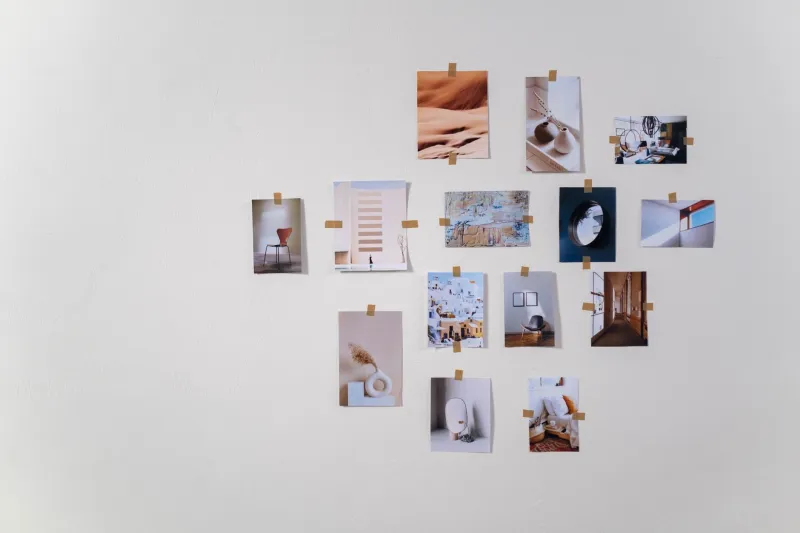
Export your twenty favorite images from the audit and lay them out in a simple grid — printed, taped to a wall, or in any free collage app. No captions. Step back. The palette will announce itself.
The Cut-Paper Collage
Old school, and still the best. Print the photos at drugstore prices, cut them up, and glue the colors and shapes you love onto a piece of cardboard. You are not making art. You are making a decision aid, and the physical version forces you to commit in a way a screen never does.
The Cheapest Room Refresh
Take the two dominant colors from your audit and do one small, reversible thing with them. A lampshade. A set of dish towels. A single wall behind a bookshelf. Move one piece of furniture so the window light lands where your photos say it should. The goal is not a renovation, it is alignment.
The Playlist
Photos have a tempo. If your roll is all wide, quiet, low-contrast shots, your soundtrack is probably slower than what you have been playing while you clean. Build a ten-song playlist that matches the mood of your grid and use it while you work on the room. It sounds precious. Try it once and get back to me.
The Screenshot Problem
Screenshots are not photographs. They are other people's ideas, and they will contaminate the audit if you let them.
Create a separate album for them. Keep them, look at them, use them — but do not count them as evidence of your own taste. The whole value of this exercise is separating what you notice from what you were served.
Keep the Ugly Ones
The blurry shot of your hallway at 11 p.m. The corner of a diner that has exactly the wrong lighting but exactly the right feeling. The paint chip photo you took in a hardware store aisle because the color made you weirdly emotional.
Those are the files with information in them. The perfect photos are already finished. The ugly ones are still telling you something.
Twenty minutes a month. That is the whole ask. Your phone has been taking notes on you for years. It is time you read them.