Beautifully Wrong: Five American Homes That Never Got the Memo
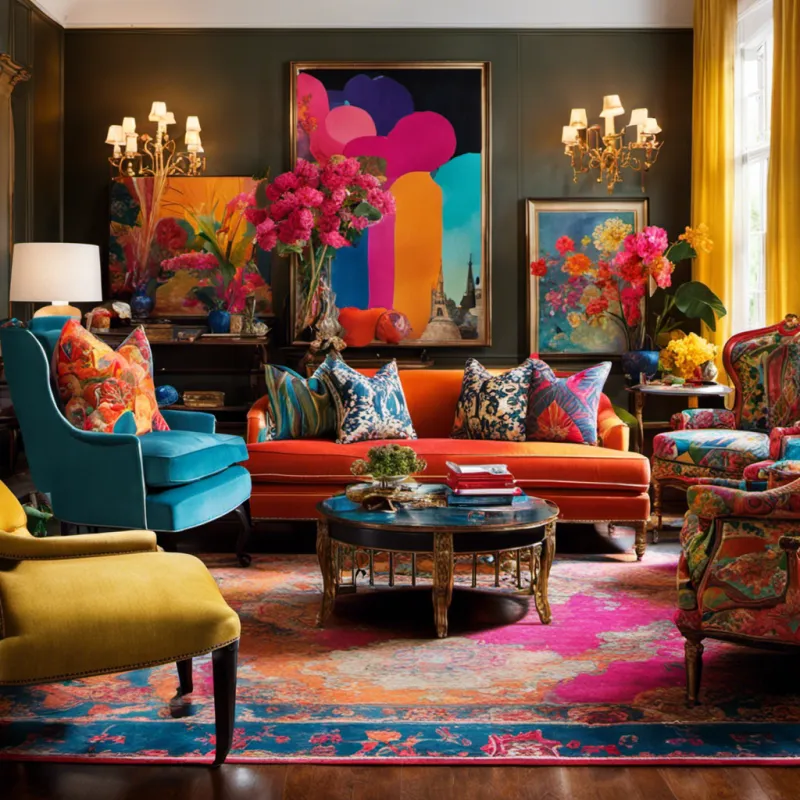
Photo: colorful maximalist living room eclectic patterns gallery wall vintage decor, via i.pinimg.com
Interior trends have a way of flattening everything. Open the app of your choice and you'll scroll through twenty homes with the same greige walls, the same arched mirrors, the same limp olive tree in the corner. Lovely? Sure. Memorable? Absolutely not. Then there are the homes in this piece — five real American spaces that broke the rules on purpose, or possibly by accident, and are better for it. None of them would survive the algorithm. All of them survive in memory.
1. The Pattern Brawl Apartment — Chicago, IL
The first thing you notice in Dana's Logan Square apartment is that nothing matches, and the second thing is that somehow everything does. Floral wallpaper butts up against a geometric kilim rug. Striped curtains argue with a leopard-print ottoman. The kitchen features not one but two competing tile patterns, separated by a grout line that has seen things.
Dana's philosophy is refreshingly blunt: "Matching is for people who are scared." Her rule isn't chaos, though — it's repetition. Every pattern in the apartment shares at least one color with its neighbor, so the whole room hums on the same frequency. It's maximalism with a grammar, and it photographs like a fever dream in the best way.
2. The Book Hoarder's Studio — Portland, OR
Marcus's 450-square-foot studio contains an estimated 3,000 books, and the shelves don't stop at the walls. There are stacks in the shower (covered), stacks under the bed, a load-bearing wall of paperbacks behind the headboard. Design advice would call this clutter. Marcus calls it "insulation for the soul."
What makes the space work isn't tidiness — it's that the books ARE the decor. Spines create the color palette. A shelf of mid-century Penguin covers does the work a $400 art print would do, with better footnotes. When friends visit, they always leave with a borrowed book and a strong opinion. "A room should start a conversation," Marcus says. "Mine starts arguments."
3. The 'Ugly' Color House — Asheville, NC
Every house on Priya's street is a tasteful shade of white, gray, or the blue-gray that realtors call "coastal." Her house is a deep, murky brownish-purple that she cheerfully describes as "the color of a bruise, or fancy ketchup." The front door is mustard. The trim is teal. The HOA has opinions.
Inside, she's doubled down: a terracotta living room, a dining room in a green she found on a salvage chip labeled "Swamp Thing." Her reasoning is disarmingly practical. "Trend colors are trend colors because they don't risk anything," she says. "I wanted a house that looks like me on my best day." It does. Nobody has ever driven past her house and forgotten it.
4. The Everything Wall Bungalow — Detroit, MI
Renee and Tom's East English Village bungalow has one rule, inherited from Renee's grandmother: every wall gets art, and no wall gets less than three pieces. Family photos hang next to flea market paintings next to a child's crayon portrait that is, objectively, terrible, and is displayed at eye level like a Vermeer.
The gallery walls aren't curated so much as populated — they grow, they get rearranged after dinner parties, they include a framed funeral program and a 1987 Detroit Tigers schedule. The effect is a house that feels less decorated than inhabited by generations. Design blogs would call it busy. The family calls it "the archive."
5. The Furniture-Free Living Room — Marfa, TX (via Brooklyn)
The most radical room on this list is the emptiest. After a decade of accumulating the standard Brooklyn starter kit, Joel moved to Marfa and got rid of nearly everything. His living room contains floor cushions, a low table made from a salvaged door, one enormous plant, and a wall painted chalkboard-black for drawing on.
"I kept buying furniture to fill a feeling," he says. "Turns out the feeling needed space, not a sofa." Visitors either find the room serene or maddening, and Joel considers both responses a success. "If your living room makes everyone comfortable, it probably isn't saying anything."
The Common Thread
Notice what these five homes have in common: not a single one was designed for a photo. They were designed for the people who live in them — their histories, their arguments, their terrible childhood art. The algorithm optimizes for the average viewer. A home optimizes for exactly one. When you choose the algorithm, you get a space that's impressive and forgettable. When you choose yourself, you get a house that could never be trended — because it could never be copied.