Creatively Clueless: The Unexpected Freedom of Tuning Out the Trend Machine
The Paradox Nobody Talks About in Design School
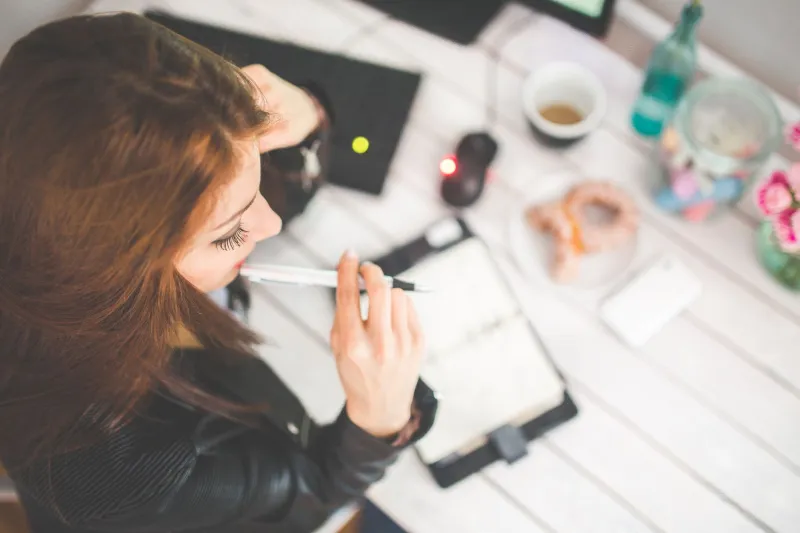
There's a strange thing that happens when you spend three hours on Pinterest looking for "inspiration." You sit down to create something and realize, with a creeping sense of dread, that everything you want to make already exists. Worse — it exists in a slightly better, more polished, more algorithmic form, and it was posted by someone with 400,000 followers at 9 a.m. on a Tuesday.
This is the trap of the inspiration economy. We've been sold the idea that consuming more — more mood boards, more design accounts, more "what's trending in 2025" roundups — makes us more creative. But a quiet, somewhat contrarian movement is pushing back hard on that assumption. Designers, painters, ceramicists, and makers across the country are deliberately going on what some of them call "trend fasts," and the work coming out of those periods of intentional ignorance? It's some of the most distinctive stuff out there right now.
What Happens to Your Brain When You Unplug from the Feed
Here's the neuroscience behind it, stripped of the jargon: your brain is a pattern-recognition machine. When you flood it with visual content — especially content that's been algorithmically selected because it already performs well — you're essentially training it to recognize and reproduce those patterns. That's not inspiration. That's mimicry in slow motion.
Cognitive researchers have a term for this: "incubation interference." When your working memory is crammed with recent inputs, your brain defaults to recombining those inputs rather than reaching into deeper, older stores of experience and memory. The good stuff — the weird, idiosyncratic, genuinely yours stuff — lives in those deeper layers. It's built from your childhood home's wallpaper, the way light hit a diner counter in Ohio, the texture of your grandmother's couch. That material doesn't get a chance to surface when you're constantly refreshing your For You page.
Selective ignorance, then, isn't about being uninformed. It's about protecting the signal from the noise.
"I Stopped Looking at Instagram for Six Months"
Brooklyn-based textile designer Maya Osei didn't set out to become a case study in creative deprivation. She just got tired. "I was making things and immediately wondering if they looked 'right' — like, right according to some invisible committee I'd never actually met," she says. "Everything I made felt like a response to what I'd seen rather than something that came from me."
So she quit. Not dramatically — she didn't delete her accounts or write a manifesto. She just stopped scrolling design content. For six months, her visual diet consisted of books she already owned, walks in her neighborhood in Bed-Stuy, and old films she'd been meaning to rewatch. Her next collection, a series of hand-woven wall pieces with an unexpectedly muted, almost archival palette, sold out in 48 hours. Buyers kept using the same word to describe it: different.
"Different is the thing everyone says they want," Maya laughs. "But you can't make different by looking at the same feeds as everyone else."
This tracks with what Austin-based furniture maker Dre Castillo has been saying for years. Dre builds custom pieces that blend Mexican craft traditions with brutalist forms — a combination that feels genuinely surprising in a market saturated with Japandi aesthetics and Scandi minimalism. His secret? He barely knows what Japandi is. "I've heard the word. I don't really know what it looks like," he says, completely unbothered. "I'm not being precious about it. I just don't find it useful to know what's happening in the design world right now. I find it more useful to know what was happening in Oaxaca in 1970."
The Trend Cycle Is a Treadmill
Let's be honest about what the trend cycle actually is: a commercial engine dressed up as culture. Trends exist to move product. They're accelerated by brands, amplified by algorithms, and monetized before most of us even realize we've absorbed them. There's nothing inherently wrong with that, but it's worth being clear-eyed about what you're plugging into when you treat trending aesthetics as creative fuel.
The irony is that the most celebrated design voices — the ones who actually shape culture rather than chase it — tend to be deeply indifferent to what's currently having a moment. They're pulling from literature, from architecture history, from personal obsession, from trips they took ten years ago. Their references are specific and strange and deeply personal, which is exactly why their work cuts through.
You don't have to be a full-time hermit to access that kind of creative depth. You just have to be willing to spend some time being creatively clueless.
How to Practice Selective Ignorance Without Losing Your Mind
This isn't about becoming a design monk who refuses all outside influence. It's about being intentional with your inputs — which is, after all, exactly what good design is about.
A few approaches that actually work:
Set a "no trend content" window. Before you start a new project, give yourself a week — or even just 72 hours — where you don't look at design accounts, trend reports, or inspiration boards. Notice what your brain reaches for instead.
Go older, not broader. Instead of scrolling for new references, go deep into something historical. A design movement from 50 years ago. A regional craft tradition. A single artist's complete body of work. Specificity is more nourishing than volume.
Make something ugly first. Give yourself permission to make a version of the thing that has no awareness of trends at all. It doesn't have to be good. It just has to be yours. You'll often find that this ugly draft contains something genuinely interesting that the polished version would have edited out.
Notice your real references. Pay attention to what you're actually drawn to when you're not looking for inspiration — the colors in your kitchen, the fonts on old packaging, the textures in your neighborhood. These are your actual aesthetic instincts, uncurated and honest.
The Most Original Thing You Can Do Is Be Yourself (No, Really)
It sounds embarrassingly simple. But in a creative landscape where the feed has become the default source of self-definition, choosing to look inward — to pull from your own specific, weirdo, irreproducible experience — is genuinely countercultural.
The artists and designers doing the most interesting work right now aren't necessarily the most plugged-in. They're the ones who've gotten comfortable with a certain kind of creative solitude. They've accepted that not knowing what's trending isn't a liability. It's a competitive advantage.
Tune out. Make something strange. See what happens.