Gloriously Unfinished: How Embracing Your Creative Mess Is the Most Radical Thing You Can Do Right Now
Let's start with a confession: the most beautiful thing in your home might be the thing you almost threw away.
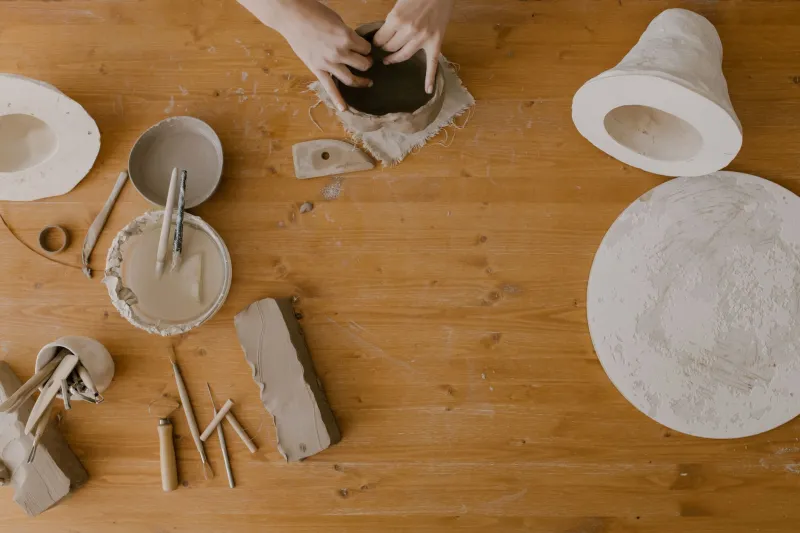
Maybe it's the watercolor you stopped halfway through because the edges bled wrong. The ceramic bowl you made at that Saturday pottery class that came out lopsided. The gallery wall you assembled without a level because you ran out of patience. You've probably walked past these things a hundred times, quietly embarrassed by them. But here's what nobody told you — those imperfections? They're doing more creative heavy lifting than anything you've ever carefully curated off a mood board.
We are living through a full-scale aesthetic rebellion against polish, and honestly, it's about time.
The Tyranny of the Perfect Grid
Somewhere along the way — probably around the time Instagram turned every living room into a showroom — we started confusing finished with good. The all-white kitchen. The symmetrical bookshelf. The seamless, shadowless product shot. These things became shorthand for taste, for success, for having your life together.
But something strange happened. The more perfect everything looked online, the less interesting it became to actually look at. Scroll fatigue is real, and it's not just because there's too much content — it's because so much of it feels like it was made by the same invisible hand, optimizing for approval instead of expression.
Perfectionism, it turns out, is not a creative virtue. It's a creative cage.
Psychologists have been saying this for years. Research consistently shows that the relentless pursuit of flawlessness doesn't produce better work — it produces less work, more anxiety, and a deep reluctance to start anything new. When your internal standard is impossibly high, the blank canvas stops being exciting and starts being threatening. You don't make the thing. You think about making the thing, and then you reorganize your desk instead.
The Artists Who Got There First
The fine art world has always had a complicated, knowing relationship with imperfection. Jean-Michel Basquiat's raw, scratchy, deliberately unresolved canvases sold for millions precisely because they looked like they were made by a human being in the grip of something urgent. There was no smoothing over the rough parts — the rough parts were the point.
More recently, ceramicist and designer Simone Bodmer-Turner has built a devoted following making organic, asymmetrical vessels that look like they grew rather than were thrown. Her pieces don't sit perfectly on a shelf. They lean. They bulge. They're not trying to be anything other than exactly what they are, and people lose their minds over them.
In the textile world, visible mending — the practice of repairing clothes with contrasting, intentionally noticeable stitching — has gone from a niche sustainability practice to a full-blown aesthetic movement. The repair doesn't hide. It announces itself. It says: this thing was broken, and it was worth fixing, and I'm not ashamed of either of those facts.
These aren't accidents. These aren't creators who couldn't achieve polish if they tried. These are deliberate choices rooted in the understanding that authenticity is more compelling than perfection, every single time.
Wabi-Sabi Didn't Invent This, But It Named It Well
The Japanese concept of wabi-sabi — finding beauty in transience, impermanence, and incompleteness — has been floating around Western design conversations for a couple of decades now, and it's had a genuine influence on how Americans are starting to think about their homes and their creative work.
Wabi-sabi isn't about being lazy or half-hearted. It's about recognizing that the crack in the glaze, the asymmetry in the handmade object, the worn patch on the vintage rug — these things tell a story that a factory-perfect replica simply cannot. They carry time. They carry touch. They carry the evidence of a real life being lived.
Applied to creative work, this philosophy is quietly revolutionary. It asks you to consider that the thing you're embarrassed about — the wobbly line, the uneven hem, the paragraph that doesn't quite land — might be the thing that makes your work yours in a way that nothing else can.
Practical Ways to Let the Mess In
So how do you actually make the shift? How do you move from perfectionism-paralysis to creative freedom without just making excuses for sloppy work? There's a real distinction here, and it matters.
Start before you're ready. This is the oldest advice in the creative playbook, and it's still the most effective. The first draft, the first sketch, the first version of anything is supposed to be rough. Give yourself explicit permission to make something bad. The goal of the first pass is not quality — it's existence.
Keep the evidence. When you make something and it doesn't go the way you planned, resist the urge to delete, repaint, or restart immediately. Live with it for a few days. Look at it in different light. You might find that what felt like a failure is actually the most interesting version of the thing.
Put imperfect work in your space. Hang the lopsided painting. Display the wonky bowl. Use the handmade candle holder that your kid made at camp. When imperfect, human-made things live alongside you every day, you start to retrain your eye to find them beautiful instead of embarrassing.
Share before it's done. This one is scary, but it's powerful. Showing work-in-progress — whether to a friend, a small online community, or even just in a story that disappears in 24 hours — breaks the spell of secrecy that perfectionism loves to hide behind. You might be surprised by what resonates.
Mess with the medium. Try making something in a material you've never worked with before, specifically because you have no idea what you're doing. Collage. Natural dyeing. Linocut printing. Beginner's mind produces beginner's work, and beginner's work is almost always more alive than the careful output of someone who's been practicing the same technique for years.
The Work That Actually Stays With You
Think about the creative work that has genuinely moved you — the novel that kept you up past midnight, the album you played until you knew every breath and stumble, the painting you stood in front of at a museum and felt something shift in your chest. Was it perfect? Was it smooth and seamless and without a rough edge in sight?
Almost certainly not. What it was, almost certainly, was honest. It had a point of view that wasn't trying to please everyone. It had marks that couldn't have been made by anyone else. It had the particular fingerprint of a specific human consciousness, and that specificity is what made it matter.
Your flawed work — the stuff you've been hiding and apologizing for and promising yourself you'll fix later — has that fingerprint too. It always did.
The only question is whether you're willing to let it be seen.