Offline by Choice: The Creatives Going Analog and Never Looking Back

Photo by Photo by Melanie Deziel on Unsplash on Unsplash
Marcus Reeves shoots exclusively on film. Not because he can't afford a digital camera — he's a working commercial photographer in Chicago who absolutely can — but because the constraints of film do something to his work that he's never been able to replicate with pixels. The limited number of exposures makes him slow down, look harder, commit. The grain and the slight unpredictability of the medium give his images a quality that he describes, with characteristic directness, as "more like life."
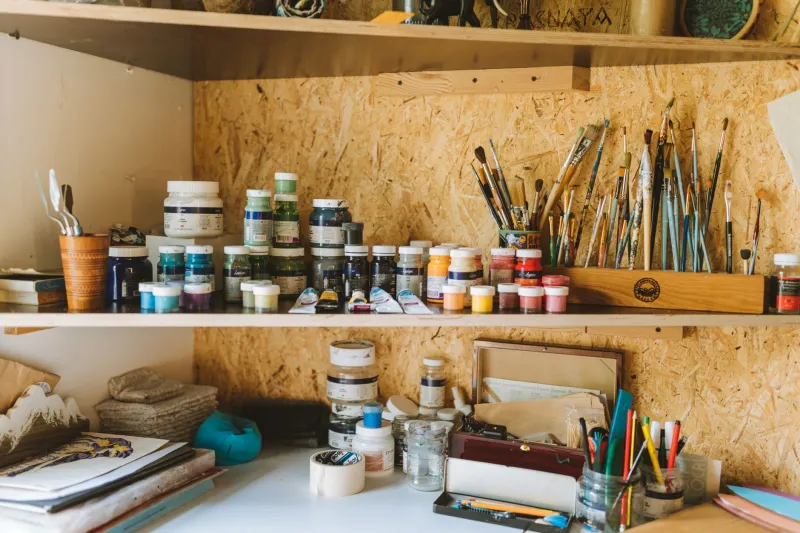
He's not alone. Across creative disciplines in the US right now, a quiet but unmistakable movement is underway. Writers working in longhand. Designers sketching on paper before touching a computer. Musicians building sounds on analog synthesizers. Illustrators working in ink and gouache. These aren't technophobes or luddites — they're people who've worked extensively with digital tools and made a deliberate choice to step back, at least partly, from the screen.
What they're finding is worth paying attention to.
The Problem With Infinite Options
Here's something nobody tells you when you're learning to use professional creative software: unlimited options are not always an asset. In fact, they can be a profound liability.
When you're working in a digital audio workstation with access to ten thousand sounds, the question "what should this sound like?" becomes almost paralyzing. When you're editing a photo with every possible adjustment available to you, the decision-making never really ends — there's always another slider to move, another filter to try, another version of the image that might be better. When you're writing in a document that can be infinitely revised and reorganized, the pressure to get it right before you commit can become a kind of creative paralysis.
Analog tools don't have this problem. They have constraints, and constraints — counterintuitively — are one of the most powerful creative forces there is.
When you're shooting on a roll of 36 exposures, you get 36 shots. That's it. The constraint forces intention. When you're writing in a notebook, the words you put down are committed in a way that digital text never quite is — you can cross out, but you can't delete, and that changes how you think before you write. When you're working on an analog synthesizer with a fixed set of parameters, you're not choosing from infinite possibility; you're exploring a defined space, and that exploration often leads somewhere genuinely surprising.
What the Body Knows
There's a physical dimension to analog creativity that doesn't get talked about enough, possibly because it's hard to quantify.
When you write by hand, your entire body is involved in the process in a way that typing simply doesn't replicate. The pressure of the pen, the movement of the wrist, the pace that handwriting imposes — these physical sensations are connected, researchers increasingly believe, to the way ideas form. Neuroscientists studying the relationship between handwriting and cognition have found that writing by hand activates parts of the brain associated with learning and memory in ways that typing doesn't. The physical act of forming letters seems to help ideas consolidate.
Similarly, the tactile experience of working with physical materials — paint, clay, film, paper — creates a kind of feedback loop between hand and mind that screen-based work interrupts. You can feel when something is working in a way that's different from seeing it on a monitor. The material pushes back; it has its own properties and preferences; it surprises you in ways that responsive software rarely does.
For many creatives, returning to analog tools is partly a return to this embodied way of working — and the ideas that emerge from it have a different quality than what comes out of hours in front of a screen.
The Focus Argument
Let's be blunt: screens are designed to fragment attention. Every notification, every tab, every embedded link is an invitation to be somewhere else. Even with apps designed to minimize distraction, working on a computer means working in an environment that is fundamentally optimized for interruption.
A notebook has no notifications. A darkroom has no Wi-Fi. An analog synthesizer doesn't have a browser. The focus that analog tools enforce is not incidental — it's one of the primary reasons serious creatives are returning to them.
Deep work — the kind of sustained, concentrated creative effort that produces genuinely original output — requires extended periods of uninterrupted attention. That's becoming harder to achieve on a screen, and many creatives are finding that the only reliable solution is to physically remove the screen from the equation.
Graphic designers who sketch by hand before opening Illustrator report that their digital work is faster and more decisive because the conceptual problem has already been solved on paper. Novelists who draft in longhand describe a different relationship with their sentences — more deliberate, more musical, less prone to the kind of surface-level tinkering that can eat hours without improving a manuscript. The analog phase isn't replacing the digital workflow; it's making the digital phase more productive.
The Luxury of Slowness
There's also something happening here that's cultural and economic in ways that are worth naming.
In 2024, speed is cheap. AI can generate a passable image in seconds, a serviceable piece of writing in minutes, a functional piece of music in an afternoon. The market for fast, adequate, algorithmically optimized creative output is saturated and getting more saturated by the week.
What's becoming genuinely scarce — and therefore genuinely valuable — is work that's slow, specific, and unmistakably human. A hand-printed letterpress poster. A film photograph with visible grain and careful composition. A journal filled with handwritten observations that took months to accumulate. These things can't be automated, and increasingly, they can't be faked.
The analog turn among serious creatives isn't nostalgia. It's a market positioning strategy, whether or not the people doing it think of it in those terms. They're making things that exist in a category that the efficiency economy can't touch.
Getting Started Without Going Overboard
You don't need to throw your laptop in the river to participate in this. The analog advantage is accessible at almost any level of commitment.
Start with one analog practice and take it seriously. A dedicated journal you write in every morning before opening your phone. A sketchbook you carry for visual observations. A film camera you shoot one roll on per month. The specific tool matters less than the consistency and the intentionality.
Resist the urge to immediately share the analog work digitally. Part of what makes these practices valuable is the privacy — the space to work without the feedback loop of likes and comments shaping what you make. Let the work exist for you first, for a while, before it becomes content.
And pay attention to what happens to your ideas when you slow down. The quality of thinking that emerges from a long, focused session with a physical medium is often qualitatively different from what comes out of a screen-based workflow. That difference is the whole point.
The Signal in the Static
There's something poetic about the fact that analog tools — with their grain, their imprecision, their physical limits — are producing some of the most vital creative work happening right now. In a culture of infinite digital smoothness, the texture of the real thing stands out.
Going offline, even partially, even temporarily, isn't a retreat from the creative conversation. It might be the most interesting move you can make in it.