Why Your Shower Is Smarter Than Your To-Do List
You've been staring at a blank canvas, a blank document, or a blank mood board for what feels like three business days. Then you give up, go make some pasta, and somewhere between boiling the water and draining the noodles — boom — the idea lands. Fully formed. Almost annoyingly perfect.
Welcome to the neuroscience of doing nothing on purpose.
American productivity culture has spent years convincing us that output is everything. More focus apps, more time-blocking, more hustle. And yet some of the most creatively alive people in the country — architects, painters, brand strategists, musicians — will quietly tell you that their best work doesn't happen at the desk. It happens in the shower. On the morning commute. While folding laundry or walking the dog around the block for the fourth time.
This isn't a coincidence. It's brain chemistry.
The Default Mode Network Is Not Your Enemy
Here's what the science actually says: when your brain isn't actively focused on a task, it shifts into what researchers call the default mode network (DMN) — a kind of mental screensaver mode that's anything but idle. The DMN is where your brain quietly synthesizes information, makes unexpected connections between unrelated ideas, and processes emotional experiences you haven't consciously dealt with yet.
Focused work — the kind productivity gurus love — activates an entirely different neural system. That system is great for executing known tasks, but it's actually pretty lousy at generating genuinely novel ideas. It's too busy being efficient to be interesting.
When you step away from the problem and go do something boring, you're not abandoning your creative work. You're handing it off to the part of your brain that's actually built for it.
Why 'Boring' Is a Design Feature, Not a Bug
Think about the physical environments where these moments tend to happen. The shower. The commute. The kitchen. These are spaces most of us have spent zero time intentionally designing for creativity — and yet they consistently outperform the home office.
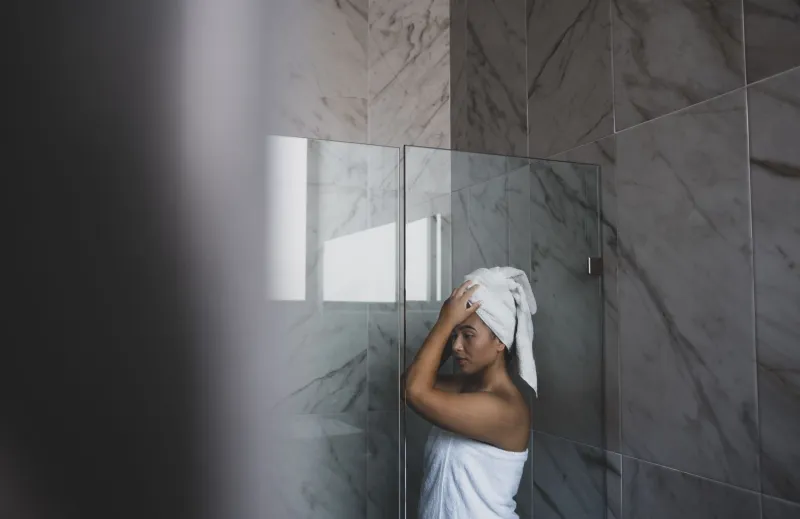
There's a reason for that. These spaces ask almost nothing of your conscious attention. The shower is warm, the motions are automatic, the sensory input is just stimulating enough to keep you present but not so demanding that your prefrontal cortex has to clock in. You're in a state of low-stakes physical engagement, which is basically a VIP pass for your subconscious to start talking.
Some designers and artists have started taking this seriously enough to actually design these moments into their homes and routines. Long, uninterrupted walks built into the morning before screens come on. Kitchens intentionally kept free of podcasts and background noise during meal prep. Commutes treated as protected thinking time rather than scrolling opportunities.
It sounds almost laughably simple. But that's kind of the point.
The People Who've Already Figured This Out
Frida Kahlo famously did some of her most significant conceptual thinking during long, uncomfortable periods of physical stillness — forced by her injuries, but creatively transformative in ways she documented extensively. Beethoven took long walks without destination, often muttering to himself, returning to compose in concentrated bursts. Steve Jobs was notorious for his walking meetings, a habit now backed by Stanford research showing that walking increases creative output by an average of 81 percent compared to sitting.
More recently, contemporary designers and creative directors across New York, LA, and Chicago have started openly talking about building deliberate downtime into their workflows — not as rest, exactly, but as a distinct phase of the creative process. One Brooklyn-based interior designer described her practice of doing a full hand-wash of dishes every morning before starting client work. No podcast. No music. Just warm water and the vague mental wandering that, she says, has generated more concept directions than any formal brainstorm session.
This isn't laziness rebranded. It's a sophisticated understanding of how creativity actually works.
How to Make Space for Strategic Nothing
The tricky part is that you can't force this. The moment you sit down in the shower with a notebook and announce that you're now going to have creative insights, your brain will absolutely refuse. The DMN doesn't perform on command. It operates in the absence of command.
What you can do is protect the conditions that allow it to show up.
Resist the reflex to fill every gap. The commute doesn't need a podcast. The dishes don't need a true crime series. These small pockets of unoccupied time are where your best thinking lives — but only if you don't immediately colonize them with someone else's content.
Design your home environment for accidental thinking. This is where the Home & Design angle gets genuinely interesting. Consider what your physical spaces are asking of your brain. A bathroom with no phone, no speaker, no reading material is a creative incubation chamber. A kitchen with good light and no screen is an idea factory. These aren't deprivation tactics — they're intentional design choices that honor how your mind actually works.
Keep a low-friction capture method nearby. The insight doesn't do you any good if it evaporates before you can use it. A small waterproof notepad in the shower (yes, these exist and yes, they're worth it), a voice memo habit while driving, a dedicated notes app that opens in one tap — whatever removes the friction between the idea and the record of it.
Schedule the boring stuff. This sounds absurd, but it works. If you're deep in a creative project and feeling stuck, literally block time on your calendar for a walk, a long shower, or a solo kitchen task. Treat it with the same seriousness you'd give a client meeting. Because in a very real sense, it is one.
The Quiet Revolution Happening in Creative Spaces
There's a broader cultural shift happening here that feels worth naming. After years of optimizing everything — our sleep, our nutrition, our morning routines, our focus — a growing number of creative people in the US are pushing back against the idea that productivity is the highest value.
They're reclaiming the unscheduled hour. The purposeless walk. The long shower that runs a little too hot for a little too long. Not because they've given up on doing good work, but because they've finally understood that good work requires something that constant optimization actively destroys: mental space.
Your best ideas aren't hiding in a better app or a more aggressive focus session. They're in the quiet corners of your day that you've been rushing through. The shower already knows this. Maybe it's time you listened.